
Essential Hand Tools Every Homeowner Should Own
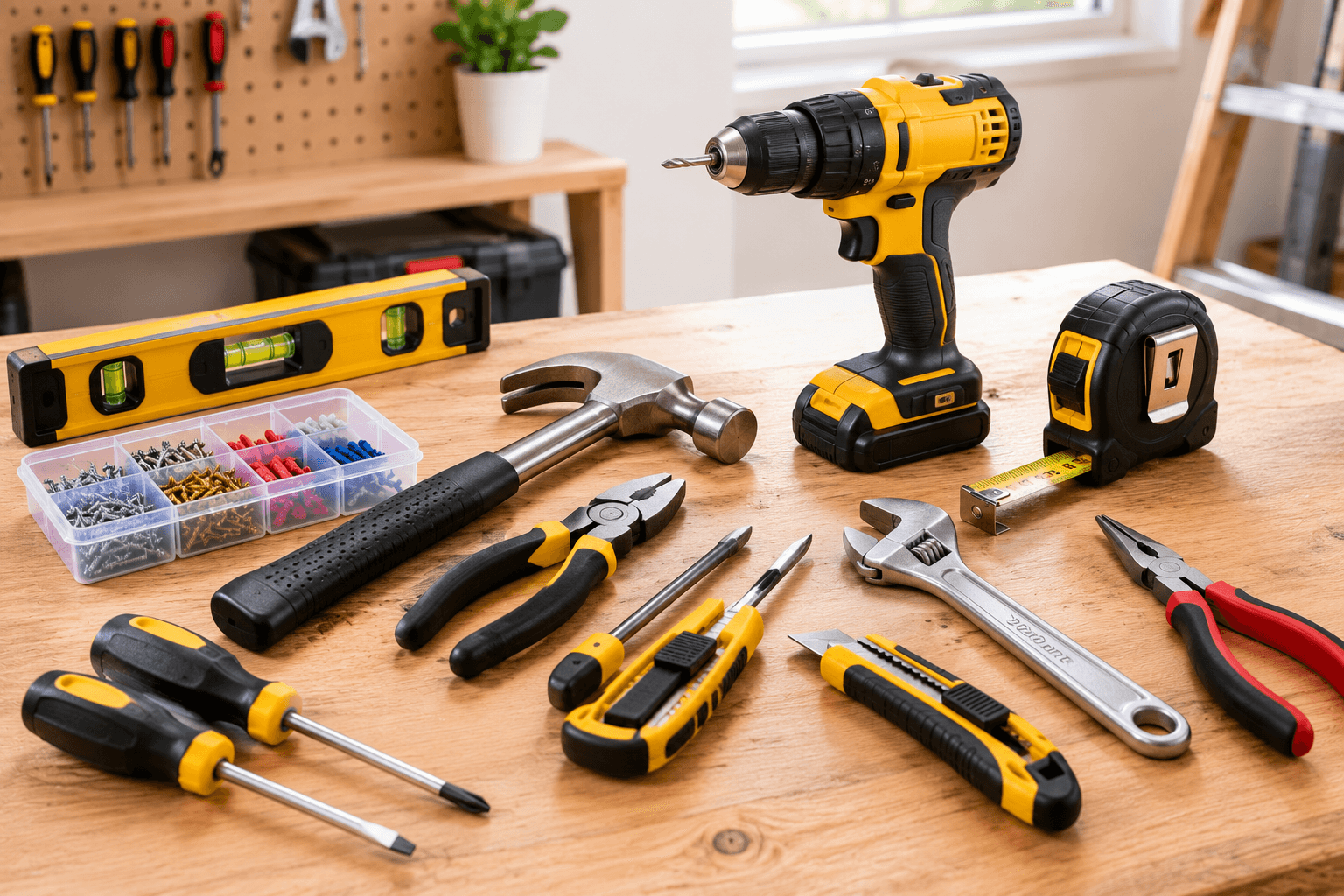
A practical, no-fluff core toolkit for homeowners. Seven hand tools that will handle 90% of everyday household repairs — plus what to actually look for when buying each.
Affiliate disclosure: We may earn a commission on purchases made through links in this article, at no extra cost to you. Learn more.
Every homeowner eventually needs to hang a picture, tighten a loose towel bar, or fix a stubborn cabinet hinge. You don't need a garage full of tools to handle these — you need seven good hand tools, chosen with care, that will last decades.
This is not a "100 tools every DIYer needs" list. It's the actual core kit: seven tools that will handle the vast majority of household repairs, with honest advice on what to spend on each.
1. Claw hammer (16 oz)
Every household needs one hammer, and it should be a 16 oz claw hammer with a smooth face. Not a framing hammer (too heavy), not a rubber mallet (too specialized), not a tack hammer (too light).
What to look for:
- 16-ounce head weight is the do-everything size
- Steel one-piece construction is nearly indestructible; fiberglass handles are lighter but flex more
- Smooth face (not "milled" or "waffle" — those are for framing and mar finished surfaces)
- A magnetic nail-starter slot is a nice-to-have that costs nothing
Skip the fancy stuff: vibration-damping grips, titanium heads, anti-shock claims. A basic Estwing 16 oz for $30 will outperform most $80 specialty hammers for household use.
2. Screwdriver — one 10-in-1 multi-bit
Old-school toolboxes had a rack of screwdrivers in different sizes. That's overkill for a homeowner. A single 10-in-1 or 11-in-1 multi-bit driver contains every bit you'll actually use:
- Phillips #1, #2, #3
- Flathead 1/4", 3/16", 1/8"
- Square/Robertson #1, #2 (increasingly common on furniture)
- 1/4" and 5/16" nut driver
Klein Tools makes the gold-standard 11-in-1 at around $22. Craftsman and Milwaukee sell competitive versions.
Pros
- One tool replaces 8-10 individual screwdrivers and stores anywhere
- Cushioned grip is comfortable for real torque
- Bits are hardened tool steel — no cam-out under normal use
- Doubles as a small nut driver for hex nuts and stove bolts
Cons
- Bits can loosen from the shaft over time — occasional tightening required
- Handle is too wide for cabinet interiors and other tight spaces
- You still need a small precision set for electronics, glasses, etc.
Also grab: a $10 precision screwdriver set with tiny Phillips and flathead bits for eyeglasses, remote-control battery covers, and children's toys.
3. Adjustable wrench (8-inch)
An 8-inch adjustable wrench (also called a "crescent wrench") is the single most useful non-plumbing wrench you can own. It'll tighten a garden-hose fitting, adjust a bike seat, grip a stuck bolt, and tighten the packing nut on a leaky faucet.
What matters:
- Smooth, precise jaw movement — cheap wrenches have sloppy jaws that round off bolts
- 8-inch is the sweet spot: 6-inch is too small for many household fittings, 10-inch is overkill
- Chrome-vanadium steel construction
Channellock, Klein, and Craftsman all make excellent 8-inch adjustable wrenches for under $25. The $6 mystery-brand versions at discount stores strip fastener heads within a year — genuinely worth spending the extra $15.
4. Spirit level (24-inch)
For hanging pictures, shelves, curtain rods, and TVs, a 24-inch level is the right size for most household applications. It's long enough to span a doorframe or level a shelf but short enough to fit in a drawer.
Look for:
- Aluminum body (not plastic — plastic warps and misreads over time)
- At least three vials: horizontal, vertical, and 45-degree
- Machined edges (feel with your finger — burrs indicate cheap manufacturing)
Stanley FatMax and Empire both sell excellent 24-inch aluminum levels for $20-30. Skip the pocket "torpedo" level as your only level — it's too short to span most surfaces you actually need to level.
5. Tape measure (25-foot)
Twenty-five feet is the do-everything length: long enough to measure a room, short enough to handle comfortably. Look for:
- Wide blade (1" or 1-1/4"): the blade stays rigid when extended, so you can measure across a room single-handed
- Standout of at least 8 feet: how far the blade extends before drooping
- Belt clip and blade lock
- Both fractional inches and metric if you ever work with foreign fixtures
Stanley FatMax 25-foot ($22) is the classic. Milwaukee makes an excellent premium version at $35 with a much longer standout.
6. Utility knife (retractable)
A utility knife is the tool that lives in your pocket during any project. Opening boxes, scoring drywall, trimming caulk, cutting weatherstripping, sharpening a pencil — it's the constant companion tool.
Look for:
- Retractable blade (safer for a household drawer than a fixed blade)
- Metal body — plastic ones develop wobble in the blade
- Standard interchangeable blades (Stanley/Husky-style trapezoid blades are the standard)
- Storage for spare blades in the handle
Stanley's classic yellow-and-black utility knife ($10) and Milwaukee's Fastback ($15, one-hand opening) are both excellent. Change the blade the moment it stops cutting cleanly — dull blades cause more injuries than sharp ones because you push harder.
7. Pliers — a two-tool set
Two types of pliers cover 90% of household needs:
Tongue-and-groove pliers (10-inch) — the ones with the movable pivot, sometimes called "Channellocks" after the brand. Use them for gripping round objects: pipes, drain traps, faucet nuts, hex fittings. Channellock brand 10-inch at $22 is the industry standard.
Needle-nose pliers (6-inch) — long, tapered jaws for reaching into tight spaces, gripping small parts, and bending wire. The built-in wire cutter at the base of the jaws is genuinely useful. Klein or Channellock, around $18.
Together these two pliers handle nearly every household plier task. Slip-joint pliers ($8) are a fine third option but not essential.
What NOT to buy (yet)
A common mistake is to buy specialty tools "just in case" — locking pliers, hex-key sets, torque wrenches, pipe wrenches. All are useful when you need them; almost none get used in the first year. Wait until a specific project requires them, then buy the right tool for that project.
Same goes for pre-assembled tool kits. The 130-piece "homeowner kits" sold at big-box stores stuff dozens of cheap tools into a plastic case — the per-tool cost looks appealing, but the tools themselves are almost universally low-quality. You'll replace half of them within two years.
Storage: don't skip this
The most-owned tools in America are also the most-lost. A cheap plastic toolbox ($15) or a small wall-mounted pegboard turns "I own a hammer" into "I can find my hammer in ten seconds." Every hand tool listed here should have a specific spot. If you can't find a tool, you don't functionally own it.
Budget breakdown
At the time of writing, you can assemble this entire seven-tool kit from any US home center or online for about $150-180:
- Hammer: $30 (Estwing 16 oz)
- Screwdriver: $22 (Klein 11-in-1) + $10 (precision set)
- Adjustable wrench: $22 (Channellock 8")
- Level: $25 (Stanley FatMax 24")
- Tape measure: $22 (Stanley FatMax 25')
- Utility knife: $12 (Stanley retractable)
- Pliers: $22 (Channellock 10") + $18 (Klein needle-nose)
That's a set of tools that will genuinely last decades, come with lifetime warranties, and handle nearly any household repair you'll face. It's a fraction of what a poorly-chosen 130-piece kit costs — and a fraction of what you'll spend replacing bad tools three years later.
Start here. Add specialty tools as specific projects demand them. That's how a real homeowner toolkit gets built.
Frequently Asked Questions
Are pre-assembled homeowner tool kits worth buying?
Do I really need both slip-joint and needle-nose pliers?
What brand of hammer should I buy?
How many screwdrivers do I actually need?
Is a laser level better than a spirit level for hanging pictures?
About the author
Jane DIY
— Senior Reviews EditorJane has been renovating houses for 12 years and writes tool reviews you can actually act on. She currently owns and uses every drill in our roundups and does not accept manufacturer samples she cannot return.