
How to Choose the Right Circular Saw for Home Projects
A circular saw is the most versatile power saw a homeowner can own — but the specs that matter aren't the ones marketing pushes. Here's what to actually look at.
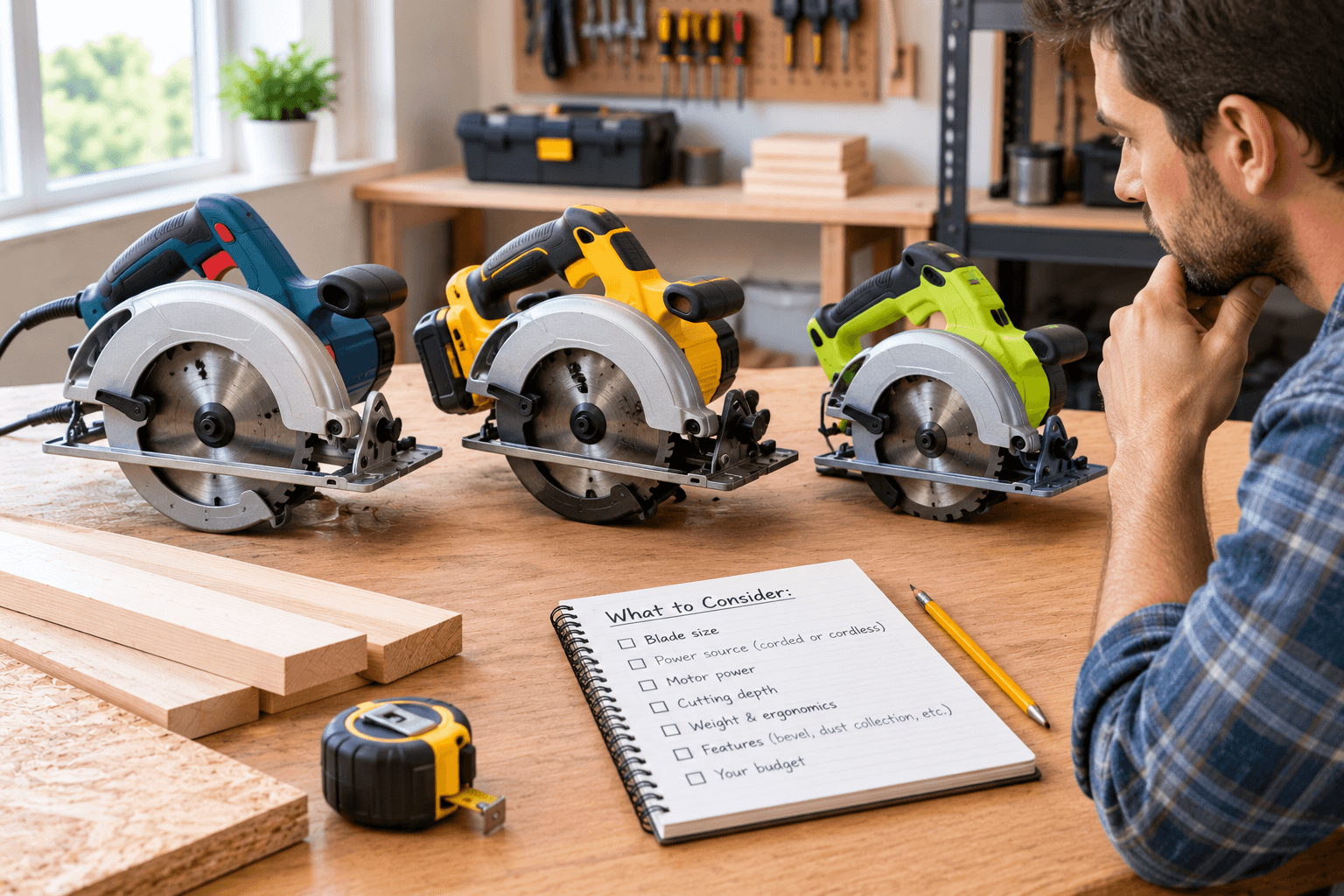
Affiliate disclosure: We may earn a commission on purchases made through links in this article, at no extra cost to you. Learn more.
If you can only own one power saw, make it a circular saw. A jigsaw is more versatile for curves, a miter saw is more accurate for repeat cuts — but a circular saw will cut lumber, sheet goods, decking, subfloor, and even (with the right blade) metal and tile. It's the closest thing to a universal cutting tool in the DIY world.
The problem is that entry-level circular saws all look identical on paper. Amps, RPM, blade size — the numbers blur together, and the specs that actually affect your day aren't the ones printed on the box. This guide walks through the decisions that matter.
Corded vs. cordless: the real trade-off
The industry has been pushing cordless hard for a decade. For circular saws, the calculus is more nuanced than for drills.
Corded saws have three real advantages: they're lighter (no battery on board), they don't slow down as they cut, and they cost half as much for the same cutting capacity. Cordless saws win on convenience and on job-site portability — no extension cord snaking behind you, no outlet dependence.
Pros
- Corded: consistent full power on long cuts, lighter tool, half the price
- Cordless: no cord to manage, works anywhere, shares batteries with your other tools
- Cordless brushless models have closed most of the power gap since 2022
Cons
- Corded: needs an outlet within extension-cord reach; harder to use on ladders and rooftops
- Cordless: 2-3 lb heavier with battery, batteries drain fast on hardwood, kits cost $180-250
- Cordless 6-1/2-inch models are common — the extra reach of 7-1/4 sometimes costs more
Blade size: 7-1/4 is the answer for 95% of homeowners
Circular saw blades are sold in 5-3/8, 6-1/2, 7-1/4, and 8-1/4 inch sizes. The 7-1/4-inch saws are dominant for good reason: replacement blades are cheap and available at every home center, cutting depth is enough for standard 2x lumber, and the tool weight is manageable.
Smaller saws (5-3/8, 6-1/2) trade cutting capacity for weight savings. They're great for trim carpentry or people with smaller hands, but you'll pay the same for blades and have half the selection.
Bigger saws (8-1/4) are worm-drive territory — for framers, not homeowners.
Amp rating (or voltage): what "power" actually means
For corded saws, the industry standard is a 15-amp motor. Anything less is a compromise; anything more is marketing. Two 15-amp saws from reputable brands will cut nearly identically.
For cordless, look at:
- Voltage: 18V or 20V-Max is the useful range. 60V saws exist but they're heavy and overkill for a homeowner.
- Battery Ah: A 4.0Ah or 5.0Ah battery is the minimum for serious cutting; 2.0Ah batteries drain fast under load.
- Motor type: Brushless is worth the upcharge on cordless — much better runtime and torque under load.
Base plate: the spec nobody talks about
The base plate (also called the "shoe") is the flat metal plate that rides on top of the material. On budget saws it's stamped from thin steel that flexes; on better saws it's a rigid magnesium casting.
Why it matters: a flimsy base plate makes it impossible to keep a straight cut, especially at bevels. If you can flex the shoe with your hand at the tool counter, expect wobbly cuts. Cast magnesium shoes are worth an extra $30 for anyone planning to cut anything requiring accuracy.
Sightline and blade visibility
Look at the front of the base plate: is there a clear notch that lines up with the blade, letting you see your cut line as you work? Some models add a laser or an LED — the laser is usually gimmicky (batteries die, alignment drifts) but a good LED that lights the cut line is genuinely useful.
Left-blade vs. right-blade saws come down to handedness. Right-handed users generally prefer a blade on the left side of the saw because it puts the cut line in view of your dominant eye. Most sidewinders sold in the US are blade-right by default; blade-left "left-handed" versions are widely available.
Blades matter more than the saw
Here's the industry's dirty secret: almost every new circular saw ships with a mediocre 24-tooth framing blade. Swap it before your first serious cut.
For a home DIY kit, own three blades:
- 24-tooth framing blade — for rough cuts in dimensional lumber and framing
- 40-tooth combination blade — for clean cuts in plywood and finish work
- 60-tooth or 80-tooth fine-finish blade — for melamine, laminate, and trim
A good 7-1/4-inch carbide blade from Diablo, Freud, or CMT runs $15-30. Cheap blades cost half as much, dull in half the time, and burn the wood.
Safety essentials
Beyond the obvious PPE (safety glasses, hearing protection), the two habits that separate people who never get hurt from people who do:
- Support both sides of your cut. If the offcut sags before the cut finishes, the blade binds and the saw kicks back. Sacrificial 2x4s under your material work fine.
- Let the saw reach full RPM before entering material. Trigger, wait one second, then cut. Trying to cut before the motor spins up is another leading kickback cause.
Wear close-fitting clothes, no loose sleeves, no dangling jewelry. Tie back long hair.
Rip fence and edge guide
Every serious circular saw accepts a rip fence — a metal arm that clamps to the base plate and rides along the edge of your material to keep cuts parallel to the edge. Most saws include a basic one; better ones fit a wider variety of aftermarket edge guides.
For long straight cuts in plywood, though, don't rely on the rip fence — clamp a straight-edge (any straight board, or a $20 straightedge clamp) to your workpiece and run the saw base against it. This is a homeowner's poor-man's track saw and works remarkably well.
Dust management
Most circular saws blow sawdust straight at your face — annoying but tolerable outdoors. Indoor cuts are worse. Look for saws with a dust port that accepts a shop-vac hose. Some brands sell adapters separately; check before you buy if indoor work matters.
For plunge cuts (starting in the middle of a panel), a proper track saw with dust extraction is far cleaner than any circular saw. If you're doing a lot of indoor kitchen or floor work, factor that in.
What to skip
- Laser guides — cheap ones drift, expensive ones aren't better than a pencil line
- "Rear-handle" ergonomic marketing — the standard sidewinder grip is fine for anyone
- 60V/80V cordless for occasional DIY — heavy, expensive, unnecessary
- Kits with cheap included blades — factor in $20 for a real blade
Recommended feature checklist
When you're standing at the tool counter (or scrolling online), match the saw against this list:
- [ ] 7-1/4-inch blade
- [ ] 15-amp motor (corded) OR 18V/20V-Max brushless (cordless)
- [ ] Cast magnesium or aluminum base plate (not stamped steel)
- [ ] Clear blade sightline; LED preferred
- [ ] Bevel capacity to at least 45 degrees, ideally 56 degrees
- [ ] Rip fence included or easily added
- [ ] Dust port that accepts a standard shop-vac hose
- [ ] Electric brake (stops the blade in 1-2 seconds after trigger release)
Any saw checking all eight boxes for under $150 (corded) or $250 (cordless, kit) is a solid buy.
The bottom line
Circular saws are one of the few tool categories where "buy nice or buy twice" is a real trap. The differences between a $90 corded Skil and a $250 corded Milwaukee are minor for a homeowner cutting a few dozen times a year. Get a mid-range 7-1/4-inch sidewinder from any major brand, put a good blade on it, and spend the savings on a proper straightedge clamp and a decent set of clamps. That combination will out-perform an expensive saw with the wrong blade every time.
Frequently Asked Questions
Is a 6-1/2-inch circular saw enough for a homeowner?
Do I need a worm-drive circular saw?
How thick can a 7-1/4-inch circular saw cut?
Should I buy a track-saw system instead?
What's the difference between a brushed and brushless circular saw?
About the author
Jane DIY
— Senior Reviews EditorJane has been renovating houses for 12 years and writes tool reviews you can actually act on. She currently owns and uses every drill in our roundups and does not accept manufacturer samples she cannot return.