
5 Best Cordless Jigsaws for Homeowners in 2026
Compare five current cordless jigsaws by handle style, speed control, cutting capacity, battery platform, and homeowner use case.
Affiliate disclosure: We may earn a commission on purchases made through links in this article, at no extra cost to you. Learn more.
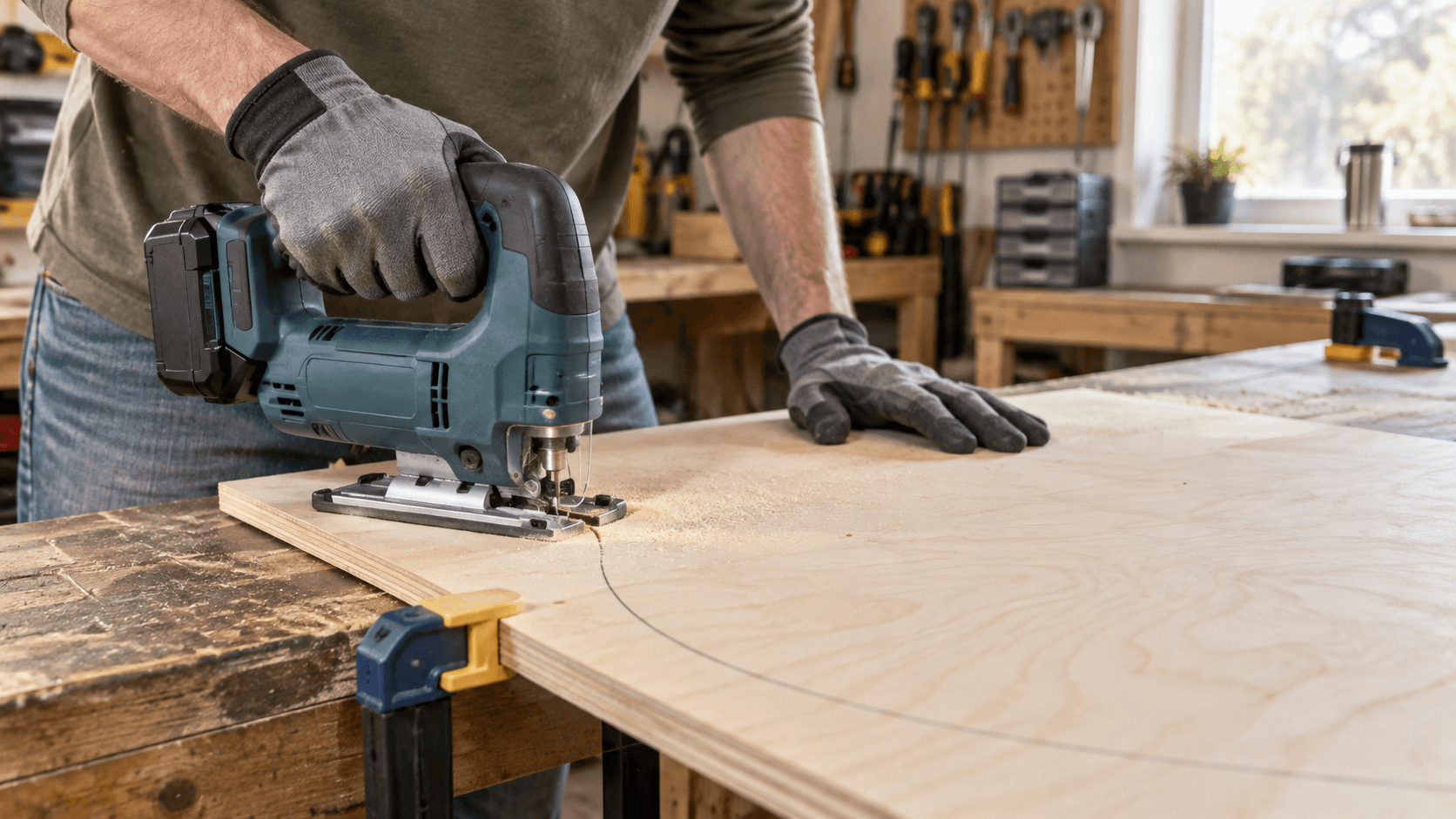
A cordless jigsaw earns its place when a project needs curves, interior cutouts, notches, or short straight cuts that are awkward for a circular saw. The difficult part is not finding a powerful model. It is choosing a handle, speed-control system, and battery platform that fit the way you actually work.
This guide compares current manufacturer-documented models. Recommendations are based on specifications, controls, included equipment, and likely homeowner use cases—not undisclosed hands-on testing.
Quick comparison
| Model | Best for | Speed | Published weight basis | Key distinction | | ----------------- | ------------------------------------------- | --------------: | ---------------------------------: | ---------------------------------------------- | | DeWalt DCS334B | Existing DeWalt 20V Max owners | Up to 3,200 SPM | Verify by package/manual | Familiar D-handle and four orbital positions | | Milwaukee 2737-20 | Frequent renovation cuts | 0–3,500 SPM | Verify with chosen battery | Tool-free bevel and switchable blower | | Makita XVJ02Z | Controlled speed selection | 800–3,500 SPM | 5.8 lb with battery | Six-speed dial and soft no-load behavior | | Bosch GST18V-50N | Buyers prioritizing published capacity data | 0–3,500 SPM | 4.4 lb bare tool | 4.9-inch wood capacity and guide compatibility | | Ryobi PBLJS01B | ONE+ homeowners | 800–3,400 SPM | Not clearly stated on current page | Tool-free bevel with 45° detents |
Best all-around for DeWalt owners: DeWalt DCS334B
The DCS334B uses a conventional top/D-handle layout and DeWalt's 20V Max battery interface. DeWalt documents a brushless motor, variable-speed trigger and dial, four-position orbital action, tool-free T-shank blade clamp, LED, dust blower, and a keyless shoe with detents at 0°, 15°, 30°, and 45°.
Those controls make it the least complicated recommendation for a homeowner already invested in DeWalt batteries. The trigger handles changes during a cut, while the dial can establish a ceiling appropriate to the material. The shoe cover helps when cutting a finished surface, but it does not replace masking, proper support, or a blade designed to limit tear-out.
Pros
- Brushless motor
- Trigger plus speed dial
- Tool-free blade and bevel adjustments
- Four orbital positions
Cons
- Battery and charger sold separately
- Platform value is weaker for first-time DeWalt buyers
- Published product page omits some comparison-friendly dimensions
Best feature set for frequent projects: Milwaukee 2737-20
Milwaukee specifies 0–3,500 strokes per minute, four orbital settings, a two-finger variable-speed trigger, tool-free blade change, and tool-free shoe bevel detents at 0°, 15°, 30°, and 45°. The blower can be switched off when using dust extraction, a useful distinction because a blower that clears a pencil line can also work against collection.
The 2737-20 is a strong fit for repeated renovation work where quick adjustments matter. Its tool-only package includes an anti-splinter guard, dust tube, dust cover, hex wrench, and shoe guard. Manufacturer runtime and cut-length claims depend on a stated battery and test material, so they should not be treated as universal results.
Pros
- 0–3,500 SPM range
- Tool-free bevel adjustment
- Switchable blower
- Dust and surface-protection accessories included
Cons
- Battery and charger not included
- More capability than occasional craft cuts require
- Working weight changes with battery choice
Best for dial-based speed control: Makita XVJ02Z
Makita publishes a six-position dial covering 800–3,500 SPM, a one-inch stroke, three orbital settings plus straight cutting, and 0°–45° bevel capacity in both directions. It also lists a 5.8-pound weight with battery and maximum capacities of 5-5/16 inches in wood, 3/8 inch in mild steel, and 25/32 inch in aluminum.
The useful buying distinction is control rather than a headline capacity. The dial, variable trigger, dual LEDs, blower, and no-load speed-reduction behavior give the operator several ways to manage the start and progression of a cut. It remains important to choose the correct blade and let it track without forcing the body sideways.
Pros
- Six-speed dial
- Published material capacities
- Dual LEDs
- Tool-free T-shank blade change
Cons
- 5.8-pound published weight includes an unspecified battery
- Battery and charger excluded
- Many controls may be unnecessary for infrequent cuts
Best for clear specifications: Bosch GST18V-50N
Bosch lists 0–3,500 SPM, a one-inch stroke, 45° bevel range left and right, 4.9-inch wood capacity, 1/8-inch steel capacity, and a 4.4-pound bare-tool weight. Its die-cast aluminum footplate, overshoe, anti-splinter insert, LED, blower, orbital settings, and T-shank ejection system cover the practical fundamentals.
Compatibility with Bosch's specified guide and circle accessories gives the GST18V-50N a useful role for repeatable shapes. A guide does not make a jigsaw equivalent to a track saw: blade deflection can still occur in thick material, particularly with aggressive feed pressure or an unsuitable blade.
Pros
- Detailed published specifications
- 4.4-pound bare-tool weight
- Guide and circle accessory compatibility
- Anti-splinter insert included
Cons
- Battery and charger excluded
- Accessory compatibility must be checked by part number
- Not the cheapest route if you own another battery platform
Best for the ONE+ platform: Ryobi PBLJS01B
Ryobi's current HP Brushless D-handle model provides an 800–3,400 SPM dial, four orbital settings, LED, blade-release lever, die-cast base, non-marring shoe, and tool-free bevel adjustment with 45° left and right detents.
It is the practical selection for a homeowner who already uses ONE+ batteries and wants a capable jigsaw without opening another system. The current product page offers both tool-only and kit choices, so compare model suffixes and contents rather than assuming the displayed price includes a battery.
Pros
- ONE+ battery compatibility
- 800–3,400 SPM control
- Tool-free bevel adjustment
- Non-marring shoe included
Cons
- Current page does not present a clear weight specification
- Kit contents vary
- Platform convenience may outweigh small specification differences
How to choose
Start with the handle
A D-handle provides a familiar trigger and a clear place to grip. A barrel grip positions the hand closer to the cutting mechanism but may feel less natural to a first-time user. These five picks emphasize D-handle models so the comparison remains like-for-like.
Treat the blade as part of the tool
Use fine-tooth wood blades for cleaner cuts, more aggressive blades for fast rough work, and blades specifically rated for metal when appropriate. Tooth direction affects which face is more likely to splinter. Support the workpiece, keep the shoe flat, and never turn the saw while the blade is stationary inside the kerf.
Use orbital action deliberately
More orbital action can speed rough wood cutting but usually increases tear-out. Straight action is the safer starting point for metal, laminate, and finish-sensitive cuts. Follow the blade and tool instructions for the material.
Final recommendation
Choose within a battery platform unless another model solves a concrete control or accessory problem. The DeWalt is the familiar all-around option, Milwaukee emphasizes adjustment convenience, Makita offers detailed speed control, Bosch supplies strong published capacity data, and Ryobi makes sense for an existing ONE+ workshop.
Manufacturer sources
Frequently Asked Questions
Should a homeowner buy a cordless or corded jigsaw?
Is a barrel-grip jigsaw better than a top-handle model?
What blades do these jigsaws use?
Does more SPM guarantee a cleaner cut?
About the author
Jane DIY
— Senior Reviews EditorJane DIY is the Senior Reviews Editor for DIY Tool Guide. Her byline identifies articles she reviews for clarity, sourcing, and practical usefulness.
More from Tool Reviews & Comparisons
DeWalt DCD800 vs DCD805: Which Drill Should You Buy in 2026?
Compare the DeWalt DCD800 drill-driver and DCD805 hammer drill by modes, size, speed, capacity, package contents, and homeowner use.
DeWalt DCF850 vs DCF860: Compact or High-Torque Impact Driver?
Compare DeWalt's compact DCF850 and high-torque DCF860 impact drivers by size, speed, torque, controls, lighting, and homeowner use.
Makita XFD14 vs XPH14: Which 18V LXT Drill Should You Buy?
Compare Makita's XFD14 drill-driver and XPH14 hammer drill by torque, speed, weight, masonry capability, and package configuration.