
Milwaukee 2903 vs 2904: Drill or Hammer Drill in 2026?
Compare the Milwaukee M18 Fuel 2903 drill-driver and 2904 hammer drill by shared performance, hammer mode, controls, and homeowner use.
Affiliate disclosure: We may earn a commission on purchases made through links in this article, at no extra cost to you. Learn more.
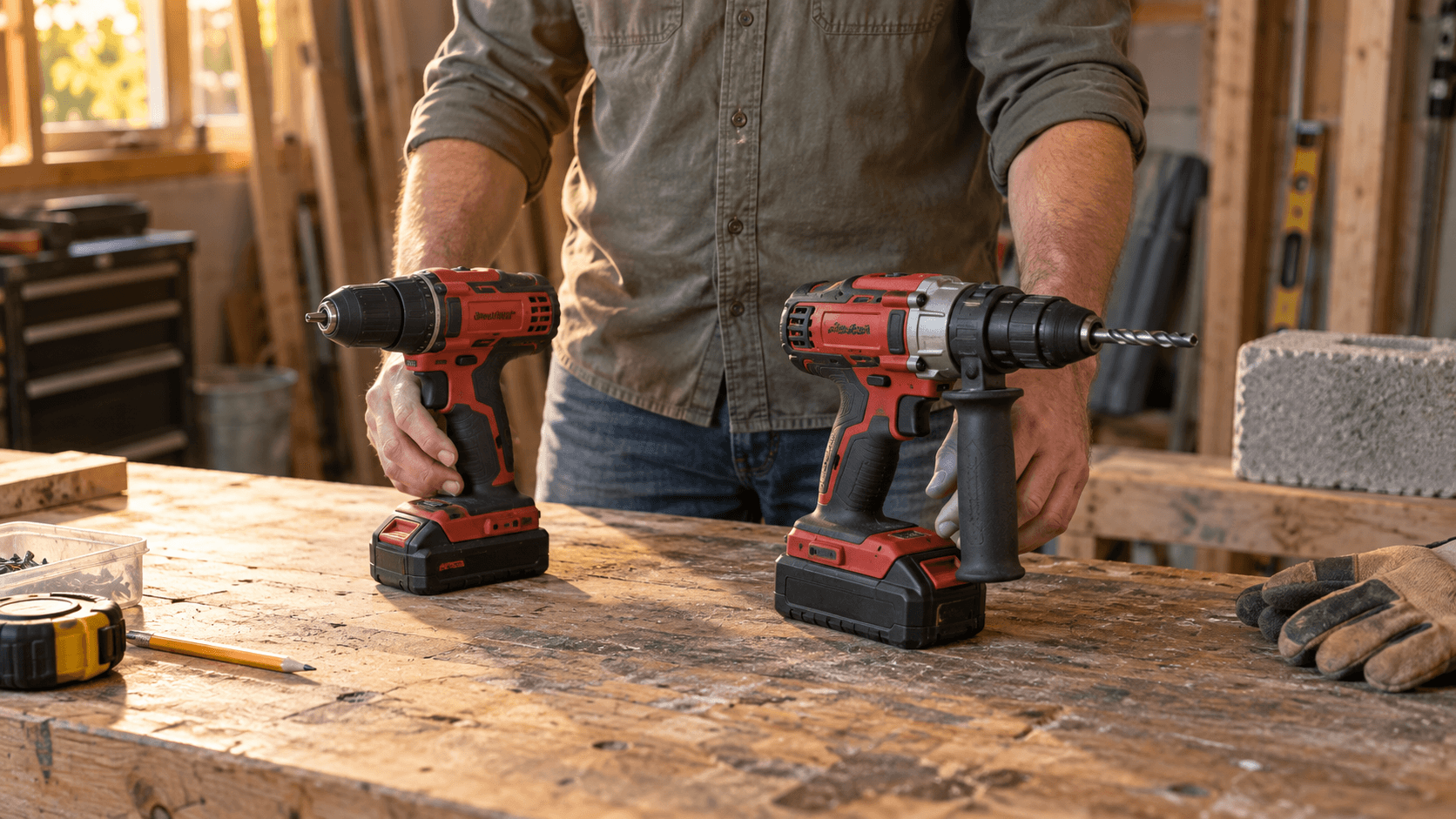
The Milwaukee M18 Fuel 2903-20 and 2904-20 are sibling drills with unusually similar core specifications. Both are 6.9 inches long, publish 1,400 in-lb of maximum torque, include a side handle, and use Milwaukee's AutoStop bind-up control. The 2904 adds hammer mode.
Side-by-side
| Feature | 2903-20 | 2904-20 | | ----------------------- | ---------------------- | ---------------------- | | Type | Drill-driver | Hammer drill-driver | | Published torque | 1,400 in-lb | 1,400 in-lb | | Published length | 6.9" | 6.9" | | Maximum published speed | Up to 2,100 RPM | Up to 2,100 RPM | | AutoStop | Yes | Yes | | Hammer mode | No | Yes | | Included with -20 | Side handle, belt clip | Side handle, belt clip |
These are manufacturer specifications, not independent measurements by this site.
Why the 2903 makes sense
The 2903 is for wood, metal, and fastening work where a percussion mechanism adds no practical value. Its all-metal 1/2-inch ratcheting chuck uses carbide teeth for bit retention, while the mechanical clutch provides repeatable fastening control. AutoStop is designed to stop rotation when the tool detects a bind-up event.
For a homeowner building cabinets, drilling framing, using hole saws, or preparing pilot holes, this is already a high-capability drill. “More modes” should not outweigh simpler operation if masonry is absent from the project list.
Pros
- 1,400 in-lb manufacturer rating
- Compact 6.9-inch length
- AutoStop bind-up control
- Metal chuck and side handle
Cons
- No hammer mode
- Bare-tool SKU excludes battery and charger
- High output requires disciplined two-hand control
Why the 2904 makes sense
The 2904 carries over the drilling and driving functions and adds hammer mode for brick, block, and concrete with suitable bits. It is the more flexible single-tool purchase when masonry anchors are a recurring need.
The extra capability does not mean hammer mode should remain engaged for ordinary drilling. Select the mode and speed before starting, use the side handle for high-reaction applications, secure the work, and follow the manual's bit and capacity guidance.
Pros
- Adds hammer mode without increasing published length
- Same torque rating and AutoStop system
- Suitable for a wider material mix
- Side handle included
Cons
- Hammer function may never be used in a wood-focused shop
- Not an SDS rotary hammer
- Battery choice affects total weight and output
What AutoStop does—and does not do
Large bits can catch and make the tool body rotate. Milwaukee describes AutoStop as an enhanced-safety control that detects over-rotation during a bind-up. It is useful, but it does not replace a stable stance, correct side-handle installation, two-hand control, sharp bits, or adherence to rated capacities.
Which should a homeowner buy?
Choose the 2903 if your work is predominantly wood, metal, and fasteners. Choose the 2904 if you regularly drill masonry and want one M18 tool for both roles. If concrete work is frequent or involves larger holes, compare the cost of the 2903 plus an appropriate rotary hammer instead.
Existing M18 battery ownership matters more than a small promotional price difference. New platform buyers should compare a complete kit, charger, battery capacity, and their next several tools.
For broader context, see hammer drill vs regular drill and how much drill torque you need.
Verdict
The 2903 is the cleaner general-purpose choice. The 2904 is the right upgrade when masonry is an actual requirement. Because their documented core output and size are so similar, there is little reason to turn this into a power contest.
Manufacturer sources
Frequently Asked Questions
What is the difference between Milwaukee 2903 and 2904?
Do both drills have AutoStop?
Can the 2904 replace an SDS rotary hammer?
About the author
Jane DIY
— Senior Reviews EditorJane DIY is the Senior Reviews Editor for DIY Tool Guide. Her byline identifies articles she reviews for clarity, sourcing, and practical usefulness.
More from Tool Reviews & Comparisons
5 Best Cordless Jigsaws for Homeowners in 2026
Compare five current cordless jigsaws by handle style, speed control, cutting capacity, battery platform, and homeowner use case.
DeWalt DCD800 vs DCD805: Which Drill Should You Buy in 2026?
Compare the DeWalt DCD800 drill-driver and DCD805 hammer drill by modes, size, speed, capacity, package contents, and homeowner use.
DeWalt DCF850 vs DCF860: Compact or High-Torque Impact Driver?
Compare DeWalt's compact DCF850 and high-torque DCF860 impact drivers by size, speed, torque, controls, lighting, and homeowner use.