
Why Your Circuit Breaker Keeps Tripping
Understand repeated breaker trips, perform safe load checks without opening the panel, and recognize overload, fault, moisture, and wiring warnings.
Affiliate disclosure: We may earn a commission on purchases made through links in this article, at no extra cost to you. Learn more.
A circuit breaker opens because it detects a condition the circuit should not continue carrying. The cause might be a straightforward overload from several appliances, but it can also be a short circuit, ground fault, arc fault, damaged cord, wet equipment, loose connection, failing appliance, or defective protective device.
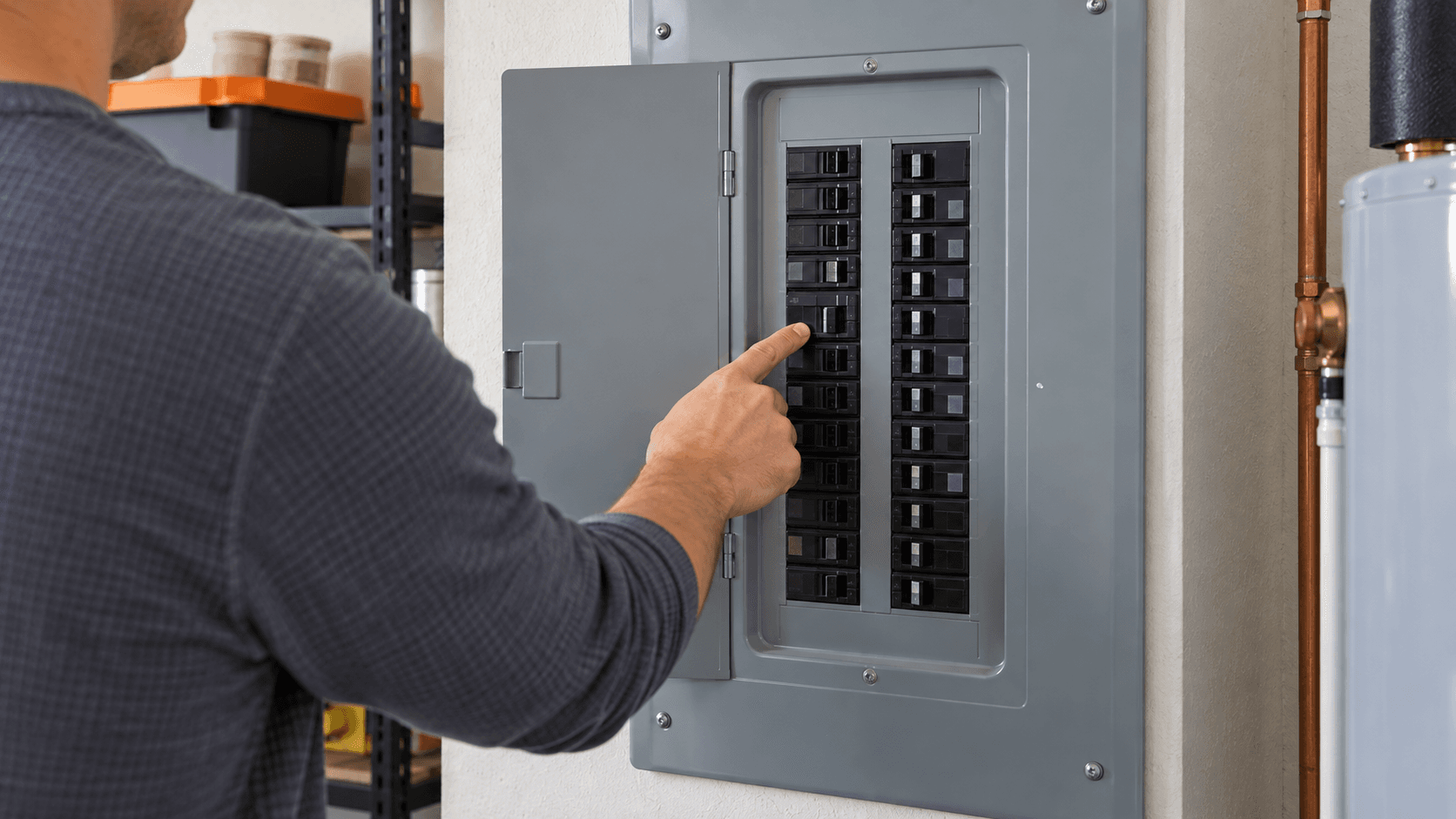
The breaker is not an inconvenience to bypass. Its trip is information. The safe homeowner workflow is limited: remove loads, look and smell for warning signs, reset the identified breaker once, and reconnect portable equipment gradually. Work inside the panel belongs to a qualified electrician.
Do not approach the panel when conditions are unsafe
Keep away and call an electrician or emergency service as appropriate if you notice:
- smoke, sparks, arcing, or flames;
- burning odor, melted plastic, soot, or discoloration;
- buzzing, crackling, or repeated clicking;
- a hot panel cover, breaker, outlet, switch, cord, or appliance;
- water, flooding, condensation, corrosion, or a damp floor near electrical equipment;
- shock, tingling, or an energized metal surface;
- a loose, damaged, missing, or open panel cover;
- a breaker handle that is cracked, stuck, or will not move normally.
Do not remove the panel's dead front. Even with the main breaker off, parts of service equipment may remain energized. Never spray water or cleaner into a panel.
Understand the protection involved
A standard circuit breaker protects conductors from excessive current caused by overloads and some faults. Other breakers add protection:
- GFCI breakers respond to current leakage that can create shock risk.
- AFCI breakers detect signatures associated with dangerous arcing.
- Dual-function breakers combine more than one protective function.
The handle or indicator may provide a trip code, but interpretation is manufacturer-specific. Read the panel and breaker instructions without removing covers. Do not assume every trip is an overload.
Identify what lost power
Before resetting anything, note which lights, receptacles, and fixed appliances stopped working. Check the panel directory, but treat it as a clue rather than proof; directories are often incomplete after renovations.
Turn off light switches and appliance controls on the affected circuit. Unplug portable equipment, including power strips and extension cords. Leave refrigerators, pumps, heating equipment, medical devices, and other critical loads to a qualified person if safe shutdown is uncertain.
If a single appliance smelled hot, sparked, was wet, or made an abnormal sound, keep it unplugged.
Reset the breaker once
When the panel is dry, intact, cool, quiet, and safely accessible:
- stand on a dry surface with dry hands;
- keep your body to the side rather than directly in front of the panel;
- locate the breaker that is OFF or between ON and OFF;
- move its handle fully to OFF;
- move it once to ON;
- close the panel door.
If the handle will not stay on, immediately trips, feels loose, or requires unusual force, leave it off. Do not hold it in position.
Reconnect loads one at a time
If power remains on with portable loads disconnected, reconnect only one item at a time and allow each appliance to enter its normal operating mode. Motors, compressors, heating elements, and power supplies may change load after startup.
When one device triggers another trip:
- unplug that device;
- label it so no one reconnects it casually;
- do not move it to an unprotected extension cord as a workaround;
- arrange appliance service or electrical inspection.
If the breaker trips only when several otherwise normal appliances run together, the combined demand may overload the circuit. Stop using that combination. High-wattage heating appliances should generally not share one receptacle circuit through adapters or power strips.
Four broad causes of repeated trips
Overload
An overload develops when connected equipment demands more current than the branch circuit should carry. It may take time to trip because breaker response depends on the amount and duration of excess current.
Common clues include a trip after multiple appliances start, a trip after a heater runs for a while, or reliable operation when one load is removed. The correction is load management or a properly designed additional circuit—not a larger breaker installed on existing wiring.
Short circuit
A short circuit creates an unintended low-resistance path and can produce a rapid trip. Damaged cords, crushed wiring, failed switches, receptacles, light fixtures, and appliances are possible sources.
Immediate retripping is a reason to leave the breaker off. Finding the fault requires safe electrical testing and inspection.
Ground fault
Current can leak toward ground through moisture, damaged insulation, appliances, or wiring. GFCI protection is intended to interrupt this hazard quickly. Bathrooms, kitchens, garages, basements, laundry areas, and outdoor circuits deserve particular attention to water exposure.
Correct the source of moisture before attempting to restore affected equipment. A dry-looking surface does not prove internal components are safe.
Arc fault
Loose or damaged connections and conductors can create arcing. An AFCI may trip even when total load is modest. Damaged cords, pinched wires, loose plugs, failing switches, and problems in fixed wiring can all matter.
Do not defeat AFCI protection because the trip appears inconvenient or intermittent. Have the circuit and connected equipment evaluated.
What not to do
- Do not reset the breaker repeatedly.
- Do not hold or tape the handle in the ON position.
- Do not replace it with a higher amp rating.
- Do not install a different breaker type because it physically appears to fit.
- Do not remove the panel cover or touch conductors and bus components.
- Do not use an extension cord to move a heavy load to an unknown circuit permanently.
- Do not bypass GFCI or AFCI protection.
- Do not treat a power strip as a way to increase circuit capacity.
- Do not ignore warm plugs, loose receptacles, damaged cords, or flickering lights.
When an electrician is required
Arrange qualified inspection when:
- the breaker trips with portable loads removed;
- it trips immediately or repeatedly;
- a GFCI/AFCI trip code or test function indicates a problem;
- fixed appliances or hardwired equipment are involved;
- the circuit directory is unreliable and the affected circuit cannot be identified;
- outlets, switches, cords, or the panel show heat or damage;
- moisture or a plumbing leak reached electrical equipment;
- the home has obsolete, modified, or visibly deteriorated electrical equipment;
- more capacity or an additional circuit may be needed.
An electrician can measure load, verify conductor and breaker compatibility, inspect terminations, isolate branches, test protective functions, and identify hidden wiring faults.
Improve the circuit record after repair
Once the actual cause is corrected, update the panel directory with specific room and equipment descriptions. Record which GFCI devices protect downstream outlets and retain appliance service information. Accurate mapping shortens future troubleshooting without changing the electrical system.
Test GFCI and AFCI protection at the interval and by the method specified by the manufacturer. A test button checks protective operation; it is not an on/off switch for daily use.
Final recommendation
Turn off and unplug affected loads, inspect for danger signs, and reset the identified breaker only once under safe conditions. Reconnect portable loads one at a time only if the circuit remains stable.
Leave the breaker off and call a qualified electrician when it trips again, trips with loads removed, or any heat, odor, noise, moisture, damage, or shock symptom is present. Never increase the breaker rating to make a trip disappear.
Sources and methodology
This article is based on public electrical-safety guidance and deliberately excludes panel-internal work, energized measurements, and breaker replacement.
Frequently Asked Questions
Is it safe to reset a tripped circuit breaker?
Why does the breaker trip when I use two appliances?
Can I replace a tripping breaker with a higher-amp breaker?
What if the breaker trips with everything unplugged?
About the author
Jane DIY
— Senior Reviews EditorJane DIY is the Senior Reviews Editor for DIY Tool Guide. Her byline identifies articles she reviews for clarity, sourcing, and practical usefulness.
More from Plumbing & Electrical
How to Fix a Running Toilet: Diagnose Before Buying Parts
Find why a toilet keeps running, test the flapper and fill valve, make safe adjustments, and know when the repair needs a plumber.
GFCI Outlet Won't Reset? Safe Checks Before You Call
Troubleshoot a GFCI receptacle that will not reset using safe external checks, and recognize moisture, wiring, and device failures for an electrician.

How to Unclog a Slow Bathroom Sink Safely
Clear a slow bathroom sink by checking the stopper and P-trap first, using mechanical methods safely, and recognizing a larger drain problem.
How to Fix a Leaky Faucet: Diagnose Before Buying Parts
Find where a faucet is leaking, identify the correct valve system and replacement part, repair it safely, and know when the problem needs a plumber.